For the last few weeks, I’ve been working on a new apologetic to answer those who say there are contradictions in the Bible. Jeremiah 34 sparked the idea. I hope you find it helpful and may God give us many opportunities to use it:
Evangelist: “The Bible says that Jesus is the Son of God who died on the cross for our sins and rose from the dead on the third day, so that whoever repents of their sin and believes in Him will not receive the due punishment for their sins, which is hell, but will receive the gift of eternal life.”
Skeptic: “But we can’t know anything about what Jesus really taught, because all we have is ancient writings that have likely been changed over the years, just like when kids play the telephone game and the final message is way different from the original.”
Evangelist: “When something is written down, it is precisely the opposite of the telephone game.”
Skeptic: “OK, but you are telling me what an English book from the 1600s says.”
Evangelist: “The King James Bible is a great translation, and all the English translations agree on these things. More importantly, the original Greek manuscripts, of which we still have more than 5,000, agree completely.”
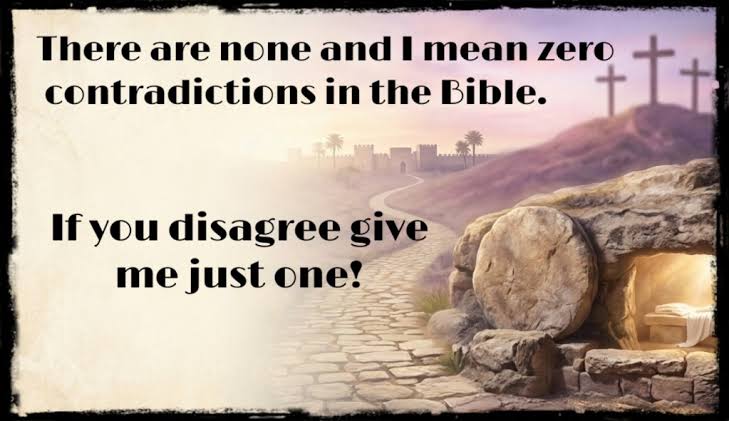
Skeptic: “The Bible books don’t even agree with themselves. There are contradictions in the Bible.”
Evangelist: “There are only apparent contradictions that upon closer examination are not contradictions at all. For example, a King of Judah said that two of God’s prophets contradicted each other*. Ezekiel said that King Zedekiah would not see Babylon; Jeremiah said that King Zedekiah would be taken to Babylon as a captive and would see the king of Babylon, face to face and eye to eye. The skeptical King Zedekiah scoffed at the two prophets, claiming that the two contradicted each other. Would you like to know what ended up happening?”
Skeptic: “What happened?”
Evangelist: “The soldiers of Nebuchadnezzar king of Babylon captured King Zedekiah and took him to Riblah. Nebuchadnezzar also captured the sons of Zedekiah. He forced Zedekiah to watch as he killed his sons right in front of his eyes. Then, so that the death of his sons would be the last thing he would see, he gouged out the eyes of the king of Judah. Obviously, there was no love lost between these two kings. Judah’s king was led captive to Babylon as a blind man.”
Skeptic: “That’s horrible. What’s the point?”
Evangelist: “The point is that the words of the two prophets (Jeremiah and Ezekiel) came true exactly. Like Jeremiah said, the king of Judah saw Nebuchadnezzar face to face and eye to eye. He was, in fact, taken to Babylon. And like Ezekiel said, the king did NOT see Babylon. He didn’t see it, because he was blind!”
Skeptic: “So you’re saying that there are no contradictions in the Bible. Anything that at first glance looks like a contradiction will prove upon closer look to be no contradiction at all.”
Evangelist: “That’s exactly what I’m saying. And I’m saying something more than that too. I’m saying that relying on a half-baked presumption that there are contradictions in the Bible cost a king everything, including his sons and his eyes. It’s a brazen thing to say that God, who breathed out the Bible, contradicted Himself. Can you tell me even one example of a contradiction in the Bible?”
Skeptic: “Well, I’m not a Bible scholar. I don’t study this stuff all day. But I heard that there are differences between the gospel writers about how many angels there were at the tomb and I heard that there are two competing creation accounts in Genesis 1 and 2.”
Evangelist: “If Matthew describes an angel outside the tomb, sitting on the giant stone after rolling it back, and Mark describes a young man in white sitting inside the tomb, this does not violate the Law of Non-Contradiction at all. A contradiction is saying A and not A regarding the same thing at the same time and in the same sense. The case of the angels at the tomb does not meet the definition of a contradiction. One angel is described as a young man in white. The description of “a young man” does not preclude him actually being an angel. In fact, angels often appear to men as men throughout the Bible. That’s not unusual or unexpected. And the presence of one angel that rolled away the stone and another angel who delivered the message to those who looked inside the tomb is not at all contradictory. It is simply describing two angels that fulfilled two different tasks.”
Skeptic: “I get that, but what about there being two creation accounts.
Evangelist: “Do you realize that the book of Genesis is one of the most influential books in the history of the world? Nothing you or I write will likely be read by anybody thousands of years from now, but you and I are sitting here talking about a book that has endured for thousands of years. How then could the author be a moron? How could he write one account and then immediately contradict himself with another?”
Skeptic: “Maybe Genesis is a compilation of two competing myths.”
Evangelist: “Even under that theory, you have the compilers of a literary masterpiece being unable to see what you in your brilliance are able to see without hardly reading it. Isn’t it much more likely that the author of one of the greatest books ever written knew exactly what he was doing? This is, again, that arrogance that I warned about in the story of Zedekiah. Why not rather read the book with an open mind, at least as open as you would be to any ordinary book? I promise you, it is very easy to read Genesis 2 as a simple zeroing in on the specifics of what Genesis 1 revealed in broad strokes.”
Skeptic: “Well, you’ve given me something to think about. I guess I was just assuming that there are contradictions.”
Evangelist: “Can I pray with you that God would soften your heart to believe His Word?”
Skeptic: “You can pray, but right now I’ve got to get to class.”
Evangelist: “Here’s a tract to take with you. It summarizes the most important ideas of the Bible. And we’ll try to be out here again, so look out for us. Or please come visit Cornerstone Church in Mt. Laurel, so we can keep talking. This is the most important conversation anyone could have. You can trust the Bible.
Skeptic: “Maybe so. See ya.”
Evangelist: “See ya.”
*Josephus, Antiquities, Book 10, Chapter 7, Section 2: “Now as to Zedekiah himself; while he heard the Prophet speak, he believed him; and agreed to every thing as true; and supposed it was for his advantage. But then his friends perverted him, and dissuaded him from what the Prophet advised; and obliged him to do what they pleased. Ezekiel also foretold in Babylon what calamities were coming upon the people: which when he heard he sent accounts of them unto Jerusalem. But Zedekiah did not believe their prophecies, for the reason following. It happened that the two Prophets agreed with one another in what they said as to all other things; that the city should be taken, and Zedekiah himself should be taken captive. But Ezekiel disagreed with him, and said, that “Zedekiah should not see Babylon:” while Jeremiah said to him, that “the King of Babylon should carry him away thither in bonds.” And because they did not both say the same thing as to this circumstance, he disbelieved what they both appeared to agree in; and condemned them as not speaking truth therein: although all the things foretold him did come to pass according to their prophecies: as we shall shew upon a fitter opportunity.”