
Keith Green wrote a modern-day song that will likely be remembered forever as one of the great hymns of the Church age: “There is a Redeemer.” In the simplest of terms, Green captured something of the value we find in having a redeemer. “There is a redeemer, Jesus, God’s own son, Precious lamb of God, Messiah, Holy one.” Let’s look to the life of Boaz to help us think about the glorious truth that Keith Green was celebrating, that there is a Redeemer.
Boaz was a Kinsman Redeemer who paid some money (Ruth 4:5) and handed over a sandal (Ruth 4:7) to acquire Naomi’s field. In the transaction, Boaz won Ruth as his bride. Better by far, Jesus is the Kinsman Redeemer who received the ends of the earth as His possession (Psalm 2:8) when He handed over the bread and cup of His own body and blood to win the Bride that is the Church. Jesus is the greater Boaz.
Interestingly, when you read the book of Ruth, we are reminded right away that the birth of the one Savior would be in one distinct place—Bethlehem. Have you ever noticed that Bethlehem is mentioned in the first verse of the book of Ruth? Check it out. Verse 2 even reiterates that Elimelech’s people were Ephrathites, underscoring the importance of Bethlehem Ephrathah to the story that follows.
The prophetic significance is that, in contrast to obedient Joseph and Mary, who would one day travel to Bethlehem for the birth of their son, Ruth 1:1 tells us that disobedient Elimelech and Naomi travelled away from Bethlehem. The righteous arrived in Bethlehem for the birth of their son and the disobedient abandoned faith in the God of Bethlehem only to suffer the death of their sons (Ruth 1:5). It is clear that they were disobedient because the sons took Moabite wives, contra Deuteronomy 7:3, “You shall not intermarry with them.” The marriages would have been OK if the women had renounced their gods and identified themselves with the God of Israel, effectively becoming Israelites, like Rahab had done when she married Boaz’s father. But the flow of the narrative of Ruth 1:1-5 is decidedly away from Bethlehem, away from God and toward assimilation with the nations.
Elimelech turned away from Israel and led his family toward the nations, but this is actually only the background narrative (Ruth 1:1-5). The story itself is about turning back to Israel, going back to Bethlehem, and there finding redemption in the God of Israel (Ruth 1:6-4:22).
When Naomi decides to return to Bethlehem, it is purely for utilitarian reasons. Ruth 1:6 tells us that she heard that things were better back in Judah. But her heart appears to be unconverted, because out of the abundance of her heart, she speaks blasphemously, “See, your sister-in-law has gone back to her people and her gods; return after your sister-in-law” (Ruth 1:15). Many Christians read this verse through their modern lens of multiculturalism and view Naomi’s counsel as if it were good and reasonable. The author of Ruth expects the reader to understand that she was advising toward idolatry!
The first sign of grace in the story appears in Ruth’s rejection of Naomi’s advice. “But Ruth said, “Do not urge me to leave you or to return from following you. For where you go I will go, and where you lodge I will lodge. Your people shall be my people, and your God my God” (Ruth 1:16 emphasis mine). This is a wholesale rejection of Moabite idolatry and a miraculous reception of Israelite identity. She will make a break with the world she has known all her life and place her life in the hands of the God of Israel.
It is the conversion of Ruth’s heart. It is also the first sign of grace toward Naomi’s heart. At the time, “she said no more” (Ruth 1:18), but that tacit acceptance was a glimmer of hope that the woman who called herself Mara, meaning bitter (Ruth 1:20), would one day believe the message of grace preached by the women of Israel, “Blessed be the Lord, who has not left you this day without a redeemer, and may his name be renowned in Israel” (Ruth 1:14).
The Gospel is the message that Jesus is the blessed Lord and the crucified and risen redeemer of all sinners who repent and believe in His Name. Naomi repented and believed a Gospel preview, that Boaz is a redeemer sent by God to Naomi.
Boaz was a kinsman, the one who secured the right to take Ruth under his wing. Jesus was our kinsman, because He became fully human by supernatural conception in the womb of Mary. He was born in Bethlehem to take headship over all who come to Him in faith. Because He is our kinsman, being fully human like us, all of us can find our rest under Him (Ruth 3:1), under His cloak as it were.
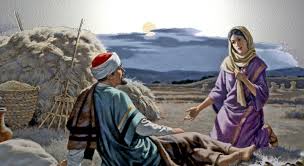
Remember the story. “At midnight the man was startled and turned over, and behold, a woman lay at his feet!” (Ruth 3:8). Remember also that Boaz was only a type of Christ. He had limited knowledge. So, he was startled when he discovered that Ruth had snuck up on him. “He said, “Who are you?” And she answered, “I am Ruth, your servant. Spread your wings over your servant, for you are a redeemer” (Ruth 3:9).
Better than Boaz, Christ always knew He was our Redeemer. As a twelve-year-old boy, He knew He was the Son (Luke 3:49), when even his parents did not fully understand (Luke 3:50). Christ also knew from all eternity whose names were “written from the foundation of the world” (Revelation 13:8); Christ knew who of us would come to Him from a far away land, fall down at His feet, and say “Spread your wings over your servant, for you are a redeemer.” Jesus Christ is omniscient, so He knows what we will do. More than that, He is the author of our salvation (Hebrews 12:2), not just the finisher. He is the one who gave us the grace of having some Ruth in our life that would bring us to the Redeemer.
The story of Ruth is the story of grace, not only to Ruth but also to Naomi. It is a type of how grace works in our lives. We must come to an end of ourselves in Moab. We must run out of hope in our idols before we turn our attention toward Bethlehem. But when we come home, it is only because He drew us home. And when we find Him there to be our Kinsman Redeemer, it is only because He first loved us (1 John 4:19). Apart from grace, no one can say and no one would care to say, “There is a redeemer, Jesus, God’s own son, Precious lamb of God, Messiah, Holy one.”
“While it is called today” (Hebrews 3:13), return to Bethlehem. Start by thanking God for whoever it was that brought you to Christ. Who was the Ruth to your Naomi? Think about how the grace of God upon their lives spilled over into yours. Thank God for them. And thank God for providing you with the Redeemer, the greater Boaz. Boaz redeemed Ruth with a sandal (Ruth 4:8); Jesus redeemed us “not with perishable things such as silver or gold” (1 Peter 1:18b), or any mere sandal, “but with the precious blood of Christ, like that of a lamb without blemish or spot” (1 Peter 1:19). Jesus is the greater Boaz, our Kinsman Redeemer.